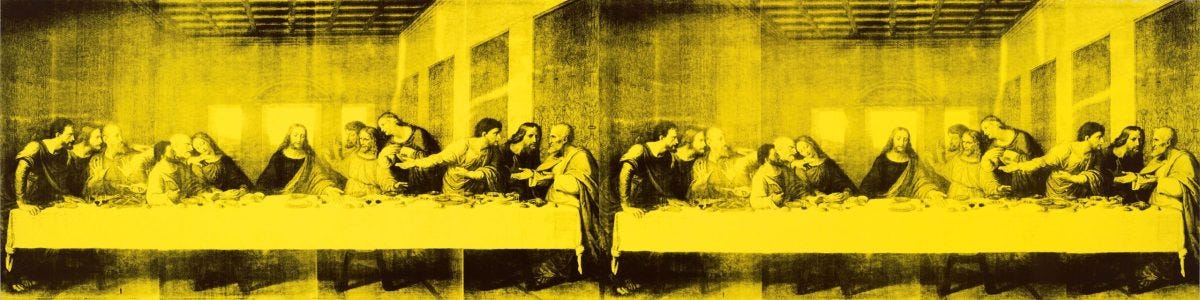
Andy Warhol's Last Supper

Bigger than the real thing, it takes up half the museum wall, because in America bigger is always better. Yet the doubling of the image makes it cheaper by the law of supply and demand. In place of Leonardo's precise contours and delicate shading, we see only grainy black silhouettes on a background of intense yellow. The color threatens to swallow the company in one atomic halo, at once heavenly and lurid. The effect is of a tabloid photo, stamped a thousand times in the press, bundled for sale on the sidewalk. Instead of a masterpiece, we have a soap opera: a dinner party gone wrong, a sensational betrayal--all too human, and endlessly repeatable. Yet this is entirely fitting. In Warhol’s Jesus, the most high God enters every part of our laughable human nature. He is present in everything tasteless, mundane, and disposable. He is flat and insubstantial, lacking any essence, just like us. He gleams in our nothingness like diamond-dust on the face of the shadow. He duplicates himself in countless agonies; he is multiplied in tawdry situations, in alleyways and bathrooms, broken into pieces, tossed into prisons, bought and sold in the marketplace, used up and tossed away, murdered and raised again and again, in every moment of every flickering quantum of creation. Recall that the author of the painting, contrary to his reputation as an aloof ironist, took in the outcast, gave bread to the hungry, and always picked up the check. In this golden mirror showing only itself, may we all partake of his pure and empty love.